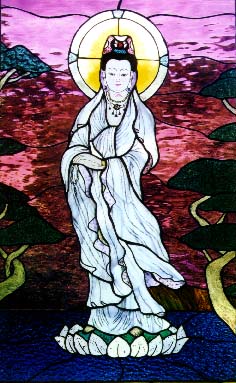
The radiant white Buddha form representing purity
and power of the enlightened mind's loving kindness and compassion is illustrated
above and at the very top of this page.
We may visualize him as a transparent, rainbow like form, like a reflection
in water, representing the empty and open aspect of awakened mind. He transcends
the solidification of concepts, including our idea that he is "out there,"
separate from us.
He sits on a lotus and the flat disc of the moon, with another moon disk behind
him, reflecting his total purity. Two of his four arms are joined in the prayer
position holding the wish fulfilling gem. In his other left hand he holds a
lotus flower and in his other right hand, a crystal mala (rosary), which he
is using to count the repetitions of his mantra, Om Mani Padme Hum, Hail to
the Jewel in the Lotus, which liberates all beings from suffering. He wears
the silks and ornaments of a Bodhisattva, representing all his special qualities,
and the soft skin of an antelope over his shoulder, symbolizing his complete
freedom from violence. He smiles with deep understanding, love and compassion
as his eyes look upon all beings.
The four arms and hands signify the four immeasurables: immeasurable loving
kindness, immeasurable compassion, immeasurable joy, and immeasurable equanimity.
Chenrezig, the Bodhisattva of Boundless Compassion, is the very embodiment and
realization of the four immeasurables. The four immeasurables are the vehicles
through which Chenrezig benefits beings.
"The first two, the inner arms, have palms joined at the heart, holding
a sky-blue, wish fulfilling jewel. This symbolizes that in whatever way Chenrezig
manifests to benefit beings, the quality of Chenrezig's mind is never separate
from the all pervasive primordial wisdom." In the outer right hand, Chenrezig
is holding crystal beads and moving them the way we use a mala to count mantras.
This symbolizes that there is not one moment when Chenrezig does not benefit
beings. Like the steady movement of counting the beads, Chenrezig is continuously
benefiting sentient beings and turning the wheel of enlightened activity.
In the outer left hand, Chenrezig holds a lotus flower. This symbolizes that
in benefiting sentient beings, Chenrezig manifests in whatever forms are necessary
in accordance with the mental capacities, circumstances, and aptitudes of sentient
beings. Chenrezig may appear in any of the different realms, such as the hell
realm or the hungry ghost realm.
"However Chenrezig may appear, he remains free from any of the samsaric
stains of the various realms, the way a lotus flower growing in a swamp appears
free of the stain of the mud. The left hand of Chenrezig, holding the flower,
symbolizes that stainlessness."
All the various features of this image have meaningful connections to the wonderful
qualities of Chenrezig, and by focusing on these details as we visualize the
image in the meditation, we can gradually awaken our own awareness of those
same qualities in ourselves.
Having trouble seeing how your real nature could be no different from that of
a being who constantly manifests unsurpassable intelligence, wisdom, compassion,
and confidence? We know we're not always compassionate, that we care much more
about the well being of certain people than about others, that we hardly know
what it would mean to give without expecting anything in return. The descriptions
of Chenrezig as consistently compassionate to all beings, impartially, is not
a common occurrence in our experiences.
The image of Chenrezig that is visualized in the meditation practice is not
a real person who happens to be perfect in every imaginable way. It is an image,
an imaginary form with wonderful qualities~Chenrezig glows in the dark, Chenrezig
even glows in the daylight. Kalu Rinpoche said, "one does not think of
the deity's body as solid or material, made of flesh and blood like one's ordinary
body, or made of metal or stone like an idol. One thinks of it as appearance
that is inseparable from emptiness, like a rainbow or like a reflection in a
mirror."
The particular wonderful qualities that Chenrezig manifests for us are just
the ones we need to get more in touch with, as aspects of our own nature, if
we want to become an enlightened buddha, or even if we just want to become a
truly compassionate person. We and the image of Chenrezig are two extremes --
we have flesh and blood bodies, but not as much compassion as we would like
to have, and Chenrezig has a body made of rainbows, and boundless impartial
compassion. When we put those two extremes together, in the Chenrezig meditation,
we move in the direction of manifesting as a being with a physical body, a body
of rainbow light and unlimited compassion.
Various aspects of the form we visualize remind us of the most important qualities
of this particular manifestation of awakened mind, the qualities we are trying
to connect to.
In visualization practice we imagine ourselves to be a Buddha, in this case
the Buddha of Compassion, Avalokiteshvara. By replacing the thought of yourself
as you, with the thought of yourself as Avalokiteshvara, you gradually reduce
and eventually remove the fixation on your personal self, which expands your
loving kindness and compassion, toward yourself and toward others, and your
intelligence and wisdom becomes enhanced, allowing you to see clearly what someone
really needs and to communicate with them clearly and accurately.
Avalokiteshvara, Chenrezig is the embodiment of that unselfish urge to look
upon each other as loving equals. If you are in need of guidance in healing,
unity, unselfishness, or the mastering of fears, you may meditate on the qualities
of Avalokiteshvara, Chenrezig {as above}, say the mantra Om Mani Padme Hum,
Hail to the Jewel in the Lotus, or you can do the following meditation.
This meditation on the thousand armed Avalokiteshvara is a visualization which
appeared when a friend asked for spiritual guidance to alleviate her suffering
... feel free to experiment with each meditation technique.
Find a quiet and comfortable space. Then, while breathing deeply for a few moments,
relax and empty your mind. In that void, picture Avalokiteshvara standing in
front of you. Repeat his name. Then imagine streams of violet light flowing
from his thousand eyes piercing the veils of glamours and illusions, dispelling
all fear and suffering surrounding you.
As you experience the veils lifting, see His thousand arms transform into shimmering
threads of golden light surrounding you in a translucent cocoon of gold. Remain
in His "embrace," in complete silence, until you experience a fully
open heart and a peaceful mind. Place your consciousness at the top of your
head. At your crown see a thousand-petaled lotus bursting through the cocoon
of gold, unfolding, revealing a diamond at its very center, radiating rainbow
hued swirling vortexes of light. Radiating from your crown and heart center,
the energies unite transforming into a thousand arms~like wings of an angel~each
possessing and bestowing enlightened compassion. Transformed, you emerge the
embodiment of compassion.
Go forth and serve … Buddhas All! As a person think in their heart, so
shall they be!
In most religious traditions one prays to the deities of the tradition in the
hopes of receiving their blessing, which will benefit one in some way. In the
Vajrayana Buddhist tradition the blessing and the power and the superlative
qualities of the enlightened beings are not considered as coming from an outside
source, but are believed to be innate, to be aspects of our own true nature.
Avalokiteshvara, Chenrezig, and his love and compassion are within us.
His Holiness, The Dalai Lama said, "Thus the six syllables, Om Mani Padme
Hum, mean that in dependence on the practice which is in indivisible union of
method and wisdom, you can transform your impure body, speech and mind into
the pure body, speech, and mind of a Buddha."
The Mani mantra is the most widely used of all Buddhist mantras, and open to
anyone who feels inspired to practice it.
Before attempting ... we suggest reading The True Sound of Truth, a wonderful
story dispelling the "fear of reciting it wrong" ....
The Mantra Om Mani Padme Hum ~ Om (ohm) Ma (mah)
Ni (nee) Pad (pahd) Me (may) Hum (hum)
"Hail to the Jewel in the Lotus"
The six syllables of the mantra ~ Om Mani Padme Hum ~ are here written in the
Tibetan alphabet:
Reading from left to right the syllables are
Om (ohm) Ma (mah) Ni (nee) Pad (pahd) Me (may) Hum (hum)
The vowel in the syllable Hu is pronounced as in the English word "book."
The final consonant in that syllable is often pronounced "ng" as in
"song." Om Mani Padme Hung.
The syllable Pad is pronounced Pe (peh) by many Tibetans: Om Mani Peme Hung.
Sanskrit form ~ Om Mani Padma Hum ~ mantra of Avalokiteshvara
Tibetan form ~ Om Mani Peme Hung ~ mantra of Chenrezig
Meaning, "Hail to the Jewel in the Lotus."
At the heart of this mantra is the seed syllable "Om" which represents
the underlying unity of all things.
The True Sound of Truth
An old story speaks about a similar problem. A devoted meditator, after years
concentrating on a particular mantra, had attained enough insight to begin teaching.
The student's humility was far from perfect, but the teachers at the monastery
were not worried.
A few years of successful teaching left the meditator with no thoughts about
learning from anyone; but upon hearing about a famous hermit living nearby,
the opportunity was too exciting to be passed up.
The hermit lived alone on an island at the middle of a lake, so the meditator
hired a man with a boat to row across to the island. The meditator was very
respectful of the old hermit.
As they shared some tea made with herbs the meditator asked him about his practice.
The old man said he had no spiritual practice, except for a mantra which he
repeated all the time to himself. The meditator was pleased: the hermit was
using the same mantra he used himself -- but when the hermit spoke the mantra
aloud, the meditator was horrified!
"What's wrong?" asked the hermit. "I don't know what to say.
I'm afraid you've wasted your whole life! You are pronouncing the mantra incorrectly!"
"Oh, Dear! That is terrible. How should I say it?"
The meditator gave the correct pronunciation, and the old hermit was very grateful,
asking to be left alone so he could get started right away. On the way back
across the lake the meditator, now confirmed as an accomplished teacher, was
pondering the sad fate of the hermit.
"It's so fortunate that I came along. At least he will have a little time
to practice correctly before he dies." Just then, the meditator noticed
that the boatman was looking quite shocked, and turned to see the hermit standing
respectfully on the water, next to the boat.
"Excuse me, please. I hate to bother you, but I've forgotten the correct
pronunciation again. Would you please repeat it for me?"
"You obviously don't need it," stammered the meditator; but the old
man persisted in his polite request until the meditator relented and told him
again the way he thought the mantra should be pronounced.
The old hermit was saying the mantra very carefully, slowly, over and over,
as he walked across the surface of the water back to the island.
In the words of Tarthang Tulku, "Compassion accepts others as they are.
One who thoroughly realizes compassion no longer sees any separation between
self and others. Compassion is the wholesome and spontaneous response to all
situations."
May these ancient teachings bring you enlightenment, and may you share it freely
with those around you. Blessings!
Excerpts, background & lower page graphics appropriated from
www.fpmt-osel.org
a wonderful site to visit for further studies on
Tibetan Buddhism and Buddhist deities.