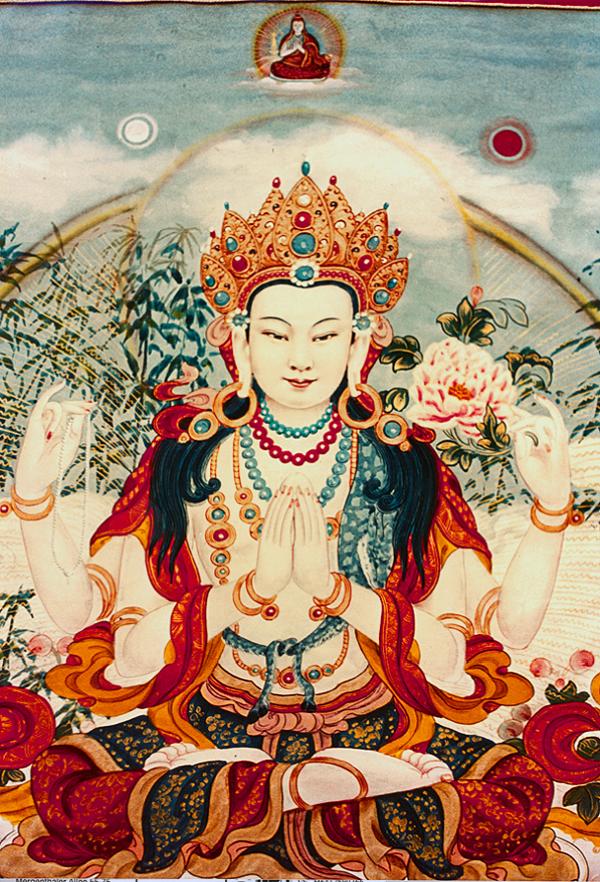
Chenrezig
In the Buddhist pantheon of enlightened beings, Avalokiteshvara (Chenrezig)
is renowned as the embodiment of the compassion of all the Buddhas, the Bodhisattva
of Compassion. Avalokiteshvara is the earthly manifestation of the self born,
primordial Amitabha, the Buddha of "Infinite Light and Boundless Compassion".
Avalokiteshvara guards this world in the interval between the historical Sakyamuni
Buddha, and the next Buddha of the Future, Maitreya. Avalokiteshvara is the
essence of great compassion focused on all sentient beings, conjoined with the
wisdom which clearly perceives that all phenomena is impermanent, and lacks
inherent (independent) existence.
According to legend, Chenrezig made a a vow that he would not rest until he
had liberated all beings from suffering. He also vowed that if he became discouraged,
he would split into many pieces. After working diligently at this task for a
very long time, he looked out and realized the immense number of miserable beings
yet to be saved. Seeing this, he became despondent, and split into thousands
of pieces. Amitabha Buddha put the pieces back together as a body with eleven
heads and 1,000 arms, so that Chenrezig could help many beings at the same time.
Depending on the meditation practice given, Chenrezig may be visualized in his
other forms; as a Buddha with one head and two arms, or most often, with four
arms.
Chenrezig is known by different names in different lands: as Avalokiteshvara
in the ancient Sanskrit language of India, as Kuan-yin in China, and as Kannon
in Japan. Whenever we are compassionate, or feel altruistic love for anyone,
for an animal or any part of the natural world, we experience a taste of our
own Chenrezig nature. Buddhists believe that we all share the same innate mind-nature
of unconditional compassion and wisdom.
"Om Mani Padme Hum" is the short mantra of Chenrezig. It is said that all the teachings of the Buddha are contained in this mantra. The sound of Aum or Om signifies the three indivisibles of body, speech and mind. Mani means jewel, and Padma means lotus. When Padma changes to Padme, it carries the additional quality of supplication. Avalokiteshvara is also called "The Jewel in the Lotus", and his mantra is "The Jewel Holder" as it holds a treasure of blessings for all who recite it. The six syllables of this mantra close the doorways to rebirth in the lower realms of cyclic existence. The six syllables also contain the essence of the six perfections of generosity, ethical discipline, tolerance or patience, joyous effort, concentration and wise discrimination.
The long mantra of Avalokiteshvara is:
Namo Ratna Trayaya, Namah Arya Jnana Sagara, Vairochana, Byuhara Jara Thathagataya,
Arhate, Samyaksam Buddhaya, Nama Sarwa Tathagata Bhyay, Arhate Bhyah, Samyaksam
Buddhe Bhyah, Nama Arya Avalokiteshvaraya Bodhisattvaya, Maha Sattvaya, Maha
Karunikaya, Tadyatha, Om Dhara Dhara, Dhiri Dhiri, Dhuru Dhuru Itte Vatte, Chale
Chale, Prachale Prachale, Kusume Kusume Vare, Ili Milli, Jiti Jvalam, Apanaye
Soha.
The Benefits of Chanting om mani padme hum
Lama Zopa Rinpoche
Excerpted from Lama Zopa Rinpoche's invitation to join the Chenrezig Institute
mani retreat, composed by Rinpoche during a stay at Deer Park Buddhist Center
in Madison, Wisconsin, USA in July 2000, scribed and edited by Ven. Lhundup
Damchö; excerpt edited by Dr. Nick Ribush. Rinpoche's entire teachings
at the retreat have been edited by Ven. Ailsa Cameron and will be published
for free distribution by the Lama Yeshe Wisdom Archive in Teachings from the
Mani Retreat, due in late 2001.
The benefits of reciting the Compassion Buddha mantra are infinite, like the
limitless sky.
Even if you don't have much intellectual understanding of Dharma, even if the
only thing you know is om mani padme hum, still the happiest life is one lived
with an attitude free of the eight worldly concerns. If you live your life with
the pure attitude free of attachment clinging to this life and simply spend
your life chanting om mani padme hum-this six-syllable mantra that is the essence
of all Dharma-that's the purest Dharma.
It looks very simple, very easy to recite. But if you think of the benefits,
it's not at all simple. Here, I'd to mention just the essence of its infinite
benefits.
Reciting the Compassion Buddha mantra just once completely purifies the four
defeats of breaking the four root vows of self-liberation and the five uninterrupted
negative karmas1.
It is also mentioned in the tantras that by reciting this mantra you achieve
the four qualities of being born in the Amitabha Buddha pure land and other
pure lands; at the time of death, seeing Buddha and lights appearing in the
sky; the devas making you offerings; and never being reborn in the hell, hungry
ghost or animals realms. You will be reborn in the pure land of Buddha or as
a happy transmigratory being.
When one who recites ten malas a day goes swimming, whether in a river, an ocean
or some other body of water, the water that touches that person's body gets
blessed.
It is said that up to seven generations of that person's descendents won't get
reborn in the lower realms. The reason for this is that due to the power of
mantra, the body is blessed by the person reciting the mantra and visualizing
their body in form of the holy body of Chenrezig. Therefore, the body becomes
so powerful, so blessed that this affects the consciousness up to seven generations
and has the effect that if one dies with a non-virtuous thought, one is not
reborn in a lower realm.
Thus, when a person who has recited ten malas of om mani padme hum a day goes
into a river or an ocean, the water that touches the person's body gets blessed,
and this blessed water then purifies all the billions and billions of sentient
beings in the water. So it's unbelievably beneficial; this person saves the
animals in that water from the most unbelievable suffering of the lower realms.
When such a person walks down a road and the wind touches his or her body and
then goes on to touch insects, their negative karma gets purified and causes
them to have a good rebirth. Similarly, when such a person does massage or otherwise
touches others' bodies, those people's negative karma also gets purified.
Such a person becomes meaningful to behold; being seen and touched becomes a
means of liberating other sentient beings. This means that even the person's
breath touching the bodies of other sentient beings purifies their negative
karma. Anybody who drinks the water in which such a person has swum gets purified.
We are unbelievably fortunate to have met the Dharma and to have the opportunity
to do recitation and meditation on the Compassion Buddha. It is an easy way
of purifying whatever negative karma we have collected, in not only this life
but in many previous lives as well.
Because we have met the Buddhadharma, and especially this method--the practice
of Compassion Buddha and recitation of his mantra--it is easy to purify negative
karma and collect extensive merit and thus to achieve enlightenment. We are
unbelievably fortunate.
Therefore, there is nothing more foolish than not taking advantage of this great
opportunity. Normally, we get continuously distracted and waste our lives. Not
only that, but all the actions done with ego and with the three poisonous minds
of anger, attachment and ignorance create negative karma, the cause of suffering.
In all existence, there is nothing more foolish than using this perfect human
body to create only suffering.
In places such as Tibet, Nepal, India and Ladakh, there's a well-established
tradition of doing the Compassion Buddha retreat and reciting 100 million om
mani padme hum mantras. The one held at Chenrezig Institute was the first such
retreat held in the West and the first in the FPMT organization. This is to
happen there once each year-only once each year!
If you're feeling guilt in your life, you can overcome this through the purification
of attending this retreat.
The retreat is not just chanting mantras with sadhanas, but also includes taking
the Eight Mahayana Precepts, if not every day, at least frequently. Whatever
merit you collect that day increases 100,000 times. This becomes such an easy
and quick way to purify, collect extensive merit, achieve enlightenment and
liberate sentient beings from unimaginable suffering and bring them to enlightenment
quickly.
Whoever attends a mani retreat is unbelievably fortunate. Even if you can't
attend the whole retreat, you can participate for two months, one month or at
least a few weeks. You can do even just one week. I especially hope this retreat
will also be established in Mongolia, since their main food is meat and so many
animals are killed there every day. This practice helps purify that. After our
temple in Mongolia has been built, I hope that thousands of people will attend
mani retreats there. Gradually too, I would like this retreat to be established
in other parts of the West.
This retreat also blesses the country where it is held and brings so much peace,
happiness and prosperity.
Even if you know the teachings on how to meditate on bodhicitta, you still need
to receive the special blessings of the deity, Compassion Buddha. You receive
these by doing the meditation and recitation we practice in the mani retreat.
Therefore, recitation of om mani padme hum is one way to actualize bodhicitta--to
transform your mind into bodhicitta and make your meditation on bodhicitta effective.
Generally, according to my experience, in my home of Solu Khumbu in the Himalayas
of Nepal, there are people who live their lives chanting om mani padme hum but
have no idea of the three principal aspects of the path--renunciation, bodhicitta
and the right view of emptiness--not even the words. Even though they can't
read and don't even know the alphabet, they have great devotion to compassion
and bodhicitta and live their lives reciting om mani padme hum. Such people
are warm-hearted, very kind, very compassionate. This is proof from my experience
that it has the effect of transforming the mind into a good heart and compassion.
Without bodhicitta, you cannot cause all the happiness for all sentient beings.
You cannot do perfect work for all sentient beings, and you cannot achieve the
complete qualities of the realizations and cessation, even for yourself.
Thus, everyone is most welcome to join the 100 million om mani padme hum mantra
retreat.
Footnotes
1. These are karmas so heavy that they ripen immediately as a rebirth in the
hell realm upon the exhaustion of the karma of this life. The five are: killing
one's mother, killing one's father, drawing the blood of a Buddha, killing an
arhat and causing disunity among the Sangha.
The Meaning Of The Short Chenrezig Mantra
Om Mani Padme Hum
MANI is method, PADME is wisdom; so MANI PADME is method-wisdom.
Buddha revealed the lesser vehicle teachings, the mahayana paramitayana teachings
and the mahayana vajrayana teachings. There is method-wisdom in the lesser vehicle
teachings, method-wisdom in the mahayana paramitayana teachings and method-wisdom
in the mahayana vajrayana teachings. So MANI PADME contains everything: the
hinayana lesser vehicle teachings of method-wisdom, the mahayana paramitayana
method-wisdom and the mahayana vajrayana method-wisdom.
By practising method-wisdom together, as signified by MANI PADME, one purifies
the stains of body, speech and mind. This is signified by the OM - A U MA -
these three sounds integrate to make OM, which signifies the vajra holy body,
holy speech and holy mind of Buddha. By practising the method-wisdom signified
by MANI PADME together, one purifies one's own ordinary body, speech and mind
and they become inseparable from Buddha's vajra holy body, holy speech and holy
mind. So the OM - AH U MA - signifies the three vajras.
Then, MANI PADME also signifies the mahaanuttarayoga tantra path. What I explained
before is general. Now, more specifically, by depending on the path of the generation
stage, which is the method of the profound secret mantra that ripens the mind,
and on the completion stage, which liberates the mind, you can cease the circle
of suffering, the base-time ordinary birth, death and intermediate state; actualize
the path-time dharmakaya, sambhogakaya, nirmanakaya; and achieve the result-time
dharmakaya, sambhogakaya, nirmanakaya. So achieving these three kayas, which
are inseparable, is signified by the OM - A U MA.
Then, another meaning of MANI PADME: PADME is lotus, MANI is jewel. The lotus
grows from mud but is unstained by the mud, so the reason why the Compassionate
Buddha is holding a lotus is to signify that the Compassionate Buddha has completely
purified and abandoned the root of samsara, ignorance - the concept of true
existence. Not only that, but the Compassionate Buddha has purified even the
subtle imprints and obscurations by the great wisdom directly perceiving emptiness.
Therefore the Compassionate Buddha is not abiding even in the lower nirvana,
the extreme of samsara. The Compassionate Buddha is not bound in that blissful
state of peace, that is why he or she - whichever way is manifested - is holding
the white lotus.
The reason why the Compassionate Buddha is holding a jewel in the hand, which
in Sanskrit is "MANI", is that the Compassionate Buddha has achieved
the highest peerless peace, the great enlightenment and because the Compassionate
Buddha's holy mind is bound by great compassion he or she is not just abiding
in that state of peace but instead manifesting in whatever form fits the different
sentient beings with their different characteristics of mind. In this way, the
Compassionate Buddha reveals various skilful means to fit the different sentient
beings, and, like a wish-granting jewel, eliminates every single problem and
suffering of the sentient beings and grants every single benefit and happiness
to the sentient beings - temporary happiness and ultimate happiness. Because
the Compassionate Buddha fulfills the wishes of all sentient beings the two
hands are put together in the mudra of holding a jewel.
Now the meaning of HUM. In the root tantra Dorje Tsemo ("Tip of the Vajra")
it is mentioned: I am going to explain the meaning of HUM. HUM destroys the
suffering. It kills the evil beings by the mantra... This means the many sentient
beings who harm or destroy the teachings of Buddha, the source of all sentient
beings' happiness. ...and it cuts the lasso of samsara. A lasso is something
that you use to tie things, like tying an animal to a stick, post or hook. The
"lasso of samsara" is attachment, which ties us to samsara. So HUM
cuts the lasso of samsara. Therefore, remember the HUM is the supreme one.
MANI PADME is the Compassionate Buddha Chenrezig's holy name. So MANI PADME
is like calling "Mum!", "Mother!" or "Father!"
MANI PADME is just like calling out to your mother or father. HUM persuades
the Compassionate Buddha's holy mind. It is an imperative: "May the blessings
of your holy mind, the great compassion, enter my heart, my mental continuum!"
So that is the essential meaning of the HUM in OM MANI PADME HUM.
Other than this, MANI is dependent-arising, the truth for the all-obscuring
mind. All of existence can be condensed into two truths: the truth for the all-obscuring
mind or dependent-arising and the truth for the absolute wisdom. So MANI signifies
the truth for the all-obscuring mind, dependent-arising, and PADME signifies
the truth for the absolute wisdom. Then HUM is the unification of dependent-arising
and emptiness.
Also, MANI is appearance. First we label "I", then there is the appearance
of an I existing from its own side, independent and unlabelled. So the MANI
signifies appearance: the appearance of samsara, nirvana, the appearance of
whatever is in this room, of oneself and others, everything. All these appearances
appear to exist from their own side and not as merely labelled by the mind.
Then PADME signifies emptiness. So you see, all these appearances including
I, action, object, samsara, nirvana, all these things that are appearing to
us as existing from their own side and not as merely labelled by the mind, all
these are completely empty, right there. They do not exist at all, not even
the slightest atom. Because everything that exists is merely labelled by the
mind, everything is empty. So MANI is appearance; PADME seeing that all these
appearances are empty of true existence; HUM the inseparability of emptiness
and appearance.
For example, while you are seeing a mirage, there is the appearance of water
but at the same time you understand that there is no water. Similarly, all these
things appear to you as truly existent but you understand at the same time that
this appearance is not real, it is empty. So MANI signifies appearance; PADME
signifies emptiness; HUM unifies these two.
From the general meaning I gave in the very first explanation of OM MANI PADME
HUM you can see that depending on how much you understand the method-wisdom
of the lesser vehicle path, the paramitayana path and the lower tantras such
as kriya tantra you can elaborate on your understanding of the mantra. There
are also ways to relate OM MANI PADME HUM to the generation and completion stages
of highest tantra, mahaanuttarayoga tantra. And you can relate OM MANI PADME
HUM just purely to the completion stage: MANI is the illusory body, PADME is
clear light, and HUM the unification of these two, the result - the unification
of no-more-learning.
So by reciting HUM, you persuade Chenrezig's holy mind and the blessings of
Chenrezig's holy mind enter into your own heart. Because of this cause blessing,
you actualize the method-wisdom of the whole path to enlightenment - sutra,
mahayana, vajrayana - which is signified by MANI PADME. Your ordinary body,
speech and mind are purified and transform into, for example, the Compassionate
Buddha's vajra holy body, holy speech and holy mind, which is signified by AH
U MA - OM.
When somebody who knows the whole path recites OM MANI PADME HUM, it is like
doing a direct meditation on the whole path to enlightenment. So by thinking
of the meaning, you can meditate on the whole path by reciting OM MANI PADME
HUM.
(Edited by Ven Sarah from a talk given in Singapore, 25 January 1993).