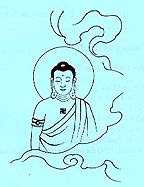
Buddha-nature pervades all sentient beings. When
the wisdom of the Great Perfection is transferred to a being, it does not matter
if that being has a sharp or intelligent mind. Why is that? It is because that
which prevents us from realizing the Great Perfection is not that this Great
Perfection is something fundamentally different or far away. If we cannot see
our own eyelid, it is not because it is far away like a distant mountain. It
is very near but difficult to see. The same is true with the nature of the mind.
Meeting Rigpa
How can we be introduced to such a nature? If we stay in a state; where we are
not influenced by thoughts of the past, we do not invite thoughts of the future,
and we are not disturbed by thoughts e of the present. In the fresh instant
of the present moment, there is a wisdom free from all concepts. We should remain
in this state without falling into drowsiness, without allowing our mind to
withdraw naturally or to wander to external objects. As Jetsun Milarepa said,
enlightenment lies in the very simple ability to recognize the wisdom beyond
thoughts, the space that is in between the thoughts. But simply to glimpse this
wisdom does not suffice: we need to achieve firmness and stability. Though all
sentient beings have Buddha-nature, they are like the young infant of a king,
a newborn prince. By nature he has royal blood, he is meant to be a king, yet
he does not have all the faculties to govern the country, protect the subjects,
defeat enemies, or administrate. It is the instruction of a teacher that will
readily help: at first to realize the view of the Great Perfection; secondly,
to achieve skill and perfect it; and thirdly, to achieve perfect stability in
this realization. We should not expect instant realization. Jetsun Milarepa
said, "Do not have expectation of the fruit, but practice until death."
In the beginning we should practice often for short periods. Our confidence
in the view will gradually grow. A time will come when 1 certainty will be born
from within. The "subject" who experiences the practice will vanish.
When the realization has fully bloomed we will become like the omniscient Longchen
Rabjam Rinpoche. We should aspire to see the vanishing point of the thoughts,
because the realization of the guru will enter through that, and merge with
our self. Lama Mipham prayed: To elaborate or to examine is nothing but adding
concepts. To make effort or to cultivate is only to exhaust oneself. To focus
or to meditate is but a trap of further entanglement. May these dissatisfying
fabrications be cut from within. We will never come to the end of intellectual
investigation. Intellectual investigation is like a small bird flying from a
ship in the ocean, trying to find the limit of the sky. The sky is so vast,
and the small bird's wings become so tired, that he has no choice than to come
back to the ship. In the same way, if we engage in mental fabrications, we will
never find an end to them. We will just tire ourselves. The view is not something
that is linked with objects, or representations, or targets. If there are such
targets or representations, there is clinging. It is said, "If there is
clinging then there is no view." A view mixed with clinging and representation
cannot be named the Great Perfection. If we have concepts we will put appearance
on one side and void-ness on the other, and in no way will we come near to the
realization of the Buddha's mind, the inseparability of void-ness and appearances
that is free from all conditions. In this way we exhaust ourselves by searching
for different methods and fabricating different exercises. We exhaust ourselves
in three ways: We create fabrications like mental concepts. We exert a lot of
effort. We create many objects or targets in our minds. These are the three
things that really tire us. It is like an insect caught in a spider's web: the
more agitated it becomes, the more tangled it gets in the web. This creates
real suffering, real torment for the mind.
If we decide that there is no need for elaboration, no need for any effort,
and no need for any targets, we will be able to rest in a state that is vast
like sky. This is the absolute nature, in which one has rid oneself of something
to be seen and a subject who sees. This is the view, the realization of the
natural state of things.
Lama Mipham wrote:
Being beyond thought or description, not a thing is seen.
There is, however, nothing extra remaining to be seen.
That is the profound meaning of resolving one's mind.
May this nature, hard to illustrate, be realized.
So what is to be done to realize the natural Great Perfection, Dzogpa Chenpo,
if it is free from all concepts, efforts, and representations? The Prajñápáramitá
Sutra says, "The perfection of wisdom is beyond thought." It should
not be conceived of, for it is inconceivable and cannot be described. The absolute
truth is not something that can be apprehended by the mind of ordinary beings.
In order to indicate this to beings, in a relative way, the Buddhas have said
that the void nature is like the sky, while its luminous expression is like
the sun. But in truth, even a Buddha cannot entirely express the nature of the
mind; there are no words or examples to explain it. It is utterly beyond the
relative mind of beings. Yet it is not something that did not exist before,
like a new thing appearing for the first time.
When we are free from all conceptualizations and mental fabrications we can
see this nature. When Karma Chagme Rinpoche realized the absolute nature, Mahamudra,
he said to his friend, "This is something that has been with me forever.
It is something I have known forever. Why didn't you tell me that this was Mahamudra
itself?" When we see the true nature within ourselves, there is nothing
more to be seen, there is nothing more to be found in the eighty-four thousand
teachings.
The Prajñápáramitá Sutra says:
Regarding mind:
Mind does not exist
its expression is luminosity.
Ground, Path, And Fruition
In The Diamond Verses of the Absolute Nature, Rigdzin Jigme Lingpa sang:
Even if a hundred learned beings and hundreds of siddhas would claim that this
view is wrong,
In this there is nothing seen to be discarded,
Nor is there anything to be kept or established.
May this state of dharmata, unspoiled by acceptance and rejection,
Be perceived as the spontaneously present nature.
Although true nature is divided into the 'ground to be known,' The 'path to
be journeyed,' and the 'fruition to be attained,' these three are but like levels
in open space. May we spontaneously abide in the nature of non-action!
In truth, in the way things really are, from the very beginning the qualities
of the essence of Buddhahood, the Tathágata-garbha, are fully bright
without modification, without losing anything at all. They are present within
every sentient being.
On the path, this essence of Buddhahood never changes: it does not increase,
nor does it decrease. It does not have to undergo any modification.
Regarding fruition again, this very essence of Buddhahood that is realized is
perfectly complete. There is nothing to be added to it. There is nothing more
that a Buddha could discover. In fact, from the point of view of the way things
are, there is no reason to make distinctions such as different bhumis or levels.
There are no such things as a starting point, a path, and a goal. All these
are like looking at the sky and trying to see different delineations, levels,
or limits within it. We can make these configurations intellectually, but in
truth there are no subdivisions in the sky. If we say, "This is the top
of the sky and this is the bottom of the sky," it is still just the sky.
In fact, there is nothing to be done, so we may abide in non-action, beyond
both action and inaction. We already have this perfect unchanging nature, so
why try to perfect ourselves, purify ourselves, attend to a teacher, and go
along the path? This question inevitably arises.
In general, the view and meditation of the eight vehicles are somewhat adulterated
by mental fabrications, but the ninth vehicle, Ati Yoga or Dzogpa Chenpo, is
completely beyond intellectual activity. A vast sky can be considered as void
or luminous, but it is all one. From the aspect of essence, it is beyond such
distinctions as view, meditation, and action. There is an "appearing aspect"
that we may call a "view," which is to find one's own nature; a "meditation,
which is to bring everything back to this single point or conviction; and an
"action," which is to gain confidence through the method of spontaneously
liberating thoughts.
Lama Mipham wrote:
Whatever one is focused on is poison for the view
whatever is embraced by effort is a fault of meditation.
Whatever is adopted or abandoned is a defect of action.
May we perceive the nature free from all shortcomings and limitations!
How should this view be? The view should be completely free from clinging. As
Manjushri said in a vision to the great Sakyapa teacher Trakpa Gyaltsen, "If
there is clinging, there is no view." The view is completely free from
conditions, concepts, and characteristics. Object, representations, targets,
and postulates are like poison to the view. With these the view cannot be pure.
If someone eats poison he will die immediately. In the same way, the view is
spoiled by clinging to either materialism or nihilism. This becomes a cause
for wandering further into samsara. Clinging in this way, we can never be free
from the bondage of ego.
According to the Dzogpa Chenpo, if one engages in striving, clinging, and tense
effort during one's meditation, it is a defect. One should remain in a view,
meditation, and action, free from fabrication. For such a yogi, whatever he
does with his body, speech, and mind, everything, even just moving his hand
in the air, takes place as the display of awareness. For this reason, there
is no need for an enlightened being to purposely cultivate virtuous actions
or discard non-virtuous actions. Whatever he does is within the display of wisdom.
The absolute expanse has never been stained or limited by concepts such as nirvana
and samsara or existing and non-existing. We should become enlightened like
the primordial Buddha Kuntuzangpo, who was enlightened in the original ground.
Aside from this very original ground of Buddhahood, it is imposing hardship
on ourselves to strive to achieve a spiritual state that we have always had.
We have Buddha-mind within, so there is no need for all these hardships; just
as when someone has already reached the diamond throne at Bodhi Gaya in India,
there is no need for them to undertake difficult travels through hard conditions
in order to get there.
The primordial Buddha, the great vidyadharas, and all those who achieved enlightenment,
merely actualized qualities they always had, they were not fabricating new qualities.
In practicing the oral pith-instructions, what we really need is to be liberated
through recognizing our own awareness, the ultimate nature of being itself.
This will not come through the so-called secret teachings and pith-instructions
found in books. The first eight vehicles take us along the path working with
the mind: none of those vehicles take wisdom itself as the path. Dzogpa Chenpo
takes the wisdom itself as the path, and it is therefore devoid of any representations
and objects. We need to utilize wisdom, how things actually are, as the path,
not merely using our mental fabrications. Because whatever is related to the
mind is automatically related to delusion, to the clinging between subject and
object.
Lama Mipham wrote:
Since the un-fabricated and uncompounded dharmata
Has nothing new to be obtained through the path of fabrications,
May the nature of the ultimate fruition, which does not result from a cause
Be perceived as being primordially present within oneself.
Vividly present and awake, free from concepts, through constant re-mindfulness
recognizing everything, wherever we are under all circumstances and conditions,
as the magical display of Rigpa; seeing through everything and never falling
prey to ego-clinging, attachment, and dualistic fixation, nor to its further
elaborations as the three poisons (kleshas) and the eighty-four thousand defilements;
thus we maintain our primordial throne, like the enlightened sovereign personifying
intrinsic awareness, Samantabhadra.
On the other hand, being deceived by this unobstructed spontaneous magical display
of intrinsic awareness itself; confused by ignorance and falling into the duality
of subject and object; thus we forego our primordial throne, depart from our
spiritual kingdom, and, like the prodigal son in the Bible, forget who and what
we are, to wander endlessly like stray dogs lost on the endless plains of samsaric
existence. The great good fortune of meeting an authentic enlightened master
and being introduced to the ultimate view, recognizing, acknowledging, confirming
our true nature, is like being reintroduced to ourselves, like the prodigal
son being restored to his rightful place as crown prince of his father's kingdom,
beyond the possibility of doubt or disputation.
All the phenomena of samsara and nirvana are perfect and complete within Rigpa.
One instant of total awareness, recognition of Rigpa, is enough: the Manjushri-namasam~iti
Tantra says, "In one moment, perfect recognition, in one instant, complete
enlightenment." The wisdom-mind of all the Buddhas, innate wakefulness,
is inherent to our very nature, yet it is temporarily obscured by conceptuality.
Innate vajra-like Buddha-mind, Rigpa, is unveiled the moment dualistic mind
dissolves and non-dual awareness nakedly dawns, which is none other than the
immaculate and primordially pure Dharmakaya. This is the authentic Buddha, the
Buddha within. There is no Buddha apart from one's own heart-mind, as Milarepa
and other siddhas often sang.
The main difference between deluded mind and enlightened mind is the degree
of narrowness and openness. The essential nature being one and undivided, it
is immediately apparent to those with eyes to see, the degree to which any particular
individual is open, free, and unconditioned or, on the other hand, rigid, close-
~r minded, fixated, attached, and confused, that is, totally conditioned by
adventitious obscurations, the karmic imprints of previous actions and obscuring
emotions and defilements.
The Ultimate Nature Of Mind
After his great awakening beneath the bodhi-tree in Bodhi Gaya, Lord Buddha
said that the ultimate nature of mind is perfectly pure, profound, quiescent,
luminous, uncompounded, unconditioned, unborn and undying, and free since the
beginning-less beginning. When we examine this mind for ourselves, it becomes
apparent that its innate openness, clarity, and cognizant quality comprise what
is known as innate wakefulness, primordial non-dual awareness: Rigpa. This is
our birthright, our true nature. It is not something missing, to be sought for
and obtained, but is the very heart of our original existential being. It is
actually inseparable from our uncontrived everyday awareness, beyond willful
alteration, free from conceptuality: un-fabricated ordinary awareness, unadulterated
by effort and modification, naked, fresh, vivid, and totally natural. What could
be simpler than this, to rest at home and at ease in total naturalness?
The sutra vehicles, the common teachings of Buddha dharma, consider that the
above-mentioned description of the ultimate nature of mind by Lord Buddha himself
refers to nirvana, or nirvanic consciousness According to the Vajrayâna
practice lineages of Tibet and especially the Mahamudra and Dzogchen traditions,
that description refers to the true nature of mind, Rigpa, intrinsic awareness
itself. In that light, how far is that fabled "other shore," nirvana?
So get out of the construction business! Stop building bridges across the raging
waters of samsaric existence, attempting to reach the "far shore,"
nirvana. Better to simply relax; at ease and carefree, in total naturalness,
and just go with the primordial flow, however it occurs and happens. And remember
this: whether or not you go with the flow, it always goes with you.
Yet it is not so easy or so it seems. First we must recognize this profound
view, innate Great Perfection, then train in it, then attain unshakeable stability
in it. This is the path of practice, un-distractedly maintaining the view or
outlook to which one has been introduced and which one has recognized. Only
then can realization progressively unfold. Thus, training implies non-meditation,
non-effort, and non-distraction, a vivid presence of mind. Innate wakefulness,
non-conceptual wisdom, non-dual primordial awareness, Buddha-mind, is suddenly
unsheathed the moment dualistic mind dissolves. This can occur gradually, through
study, analysis, and spiritual practice, or suddenly, through the coming together
of causes and conditions, such as when a ripe student encounters a totally realized
master and inexplicably experiences a sudden awakening.
Buddha-nature is pure, undefiled, unelaborated, unconditioned, transcending
all concepts. It is not an object of dualistic thought and intellectual knowledge.
It is, however, open to gnosis, intuition, the non-dual apperception of intrinsic
awareness itself, prior to or upstream of consciousness. Adventitious obscurations
temporarily veil and, like clouds, obscure this pristine, sky-like, luminous
fundamental nature or mind essence, also known as Tathagata-garbha, Buddha-nature.
All conventional practices along the gradual path to liberation and enlightenment
aim to uncover this innate wisdom by removing and dissolving the obscurations,
revealing what has always been present. This is the relation between how things
appear to be and how things actually are: in short, the two levels of truth,
absolute and relative or conventional truth. According to these two truths,
there are different levels of practice. The subtle and profound Vajrayâna
view emphasizes correctly recognizing the ultimate view, the wisdom inherent
within oneself; this is the renowned vajra-shortcut elucidated in the Dzogchen
tantras. The approach of the various sutra vehicles depends on and utilizes,
purification of dualistic consciousness, until the mind is eventually purified
and freed of obscurations and defilements. , The tantric approach depends upon,
and from the outset utilizes, wisdom, non-dual awareness, rather than mere mind.
This is a crucial difference.
The sublime view of Dzogpa Chenpo, the ultimate vehicle, is that everything
is pure and perfect from the outset. This is the absolute truth, the supreme
outlook or view of Buddhas, which implies that there is nothing that need be
done or accomplished. Based on such recognition of how things actually are,
the meditation of Dzogchen is non-meditation, resting in the evenness of being,
rather than doing any particular thing, beyond hope and fear, adopting and rejecting.
The action or behavior of Dzogchen ensues from such transcendence, and is totally
spontaneous, aimless, and appropriate to whatever conditions arise. The fruition
of Dzogchen is the innate Great Perfection itself, inseparable from the very
starting point of this swift and efficacious path: Rigpa itself, one's own true
nature.
The famous enlightened vagabond, the nineteenth century Dzogchen master Patrul
Rinpoche, sang, "Beyond both action and inaction, the supreme Dharma is
accomplished. So simply preserve the natural state and rest your weary mind."
His compassionate, humble lifestyle and profound writings are still widely studied
today, inspiring practitioners of all the sects and lineages of Tibet.
Padampa Sangye said, "Everything is found within the natural state, so
do not seek elsewhere." Buddhahood is the wisdom within us all, it is not
elsewhere. It is actually our fundamental nature, the primordial state, our
inherent freedom and un-fabricated being-ness.
That is why it is called the natural state, innate Buddha-nature, and said to
be possessed by all beings. This is the raison d'etre of Dzogpa Chenpo, the
natural Great Perfection. There is nothing beyond or superior to this. Realize
it, as it is even right now, and everything is included. All wishes and aspirations
are fulfilled in this natural state of innate wakefulness, our own innate great
perfection, Dzogchen. It belongs to each and every one of us.
Different purposes or approaches give it different names, depending on whether
it is being seen as the view, the goal, the practice path, the fundamental ground,
or otherwise. This single ineffable essence is variously known as Tathagata-garbha,
sugata-garbha, Buddha-nature, Rigpa, empty and cognizant self-existing wakefulness,
Dharmakaya, Prajñápáramitá, transcendental wisdom,
shunyata or emptiness, clear light, Buddha-mind, and so on. Rigpa, whether called
intrinsic awareness, non-dual presence, self-existing inherent wisdom, or innate
wakefulness, is like one's own individual share of the transpersonal ultimate
body of truth, the Dharmakaya of all the Buddhas. There is nothing superior
to this.
Chokyi Nyima Rinpoche said, "The enlightened essence (Buddha-nature) is
present within the heart-mind of every sentient being. Dzogchen directly introduces
and reveals how this actually is, unbarring the natural state. The pith-instructions
show how it can be nakedly recognized within one's own experience. They note
the great need for recognizing it and the tremendous benefit of doing so, clearly
showing how, at that very moment, the Buddha, the awakened state, need not be
sought for elsewhere, but is present within oneself, and that you become enlightened
through experiencing what was always present within you. This is the effect
of nyongtri, or instruction through personal experience."
As Asanga and Maitreya said, the nature of mind is luminous. It is perfectly
empty, open, and aware, unfettered by conditions or conditioning. The mind,
or dualistic consciousness, is a mere impermanent concatenation of causes and
conditions, totally bound up in conditioning. The difference between mind and
its nature, the difference between awareness or mind-essence, and conceptual
thinking or namtok, is like the difference between the sky or space itself,
and the ephemeral weather which occurs within it. In the Prajñápáramitá
Sutra Buddha says, "True mind is not the dualistic mind. The nature of
mind is actually the inseparability of awareness and emptiness."
Longchenpa says that mind is duality, that Rigpa, non-dual awareness, is transcendental
wisdom. The fundamental nature of mind is sheer lucency (i. e. is transparent),
free and unfettered by concepts such as subject and object; a profound luminosity
free from partiality and fixation, a free-flowing compassionate expression of
indefinable, limitless emptiness, un-obscured by thinking. Thought is bondage;
the immeasurable openness of empty awareness is freedom. Compassion for those
bound within their own illusory constructs, mind forged manacles, and self-imposed
limitations, spontaneously, un-obstructed, and inexhaustibly springs forth.
Therefore, with the essential pith-instructions of a qualified Dzogchen master,
crush the eggshell of the mind and unfold your wings in the open sky. Destroy
the hut of duality and inhabit the expansive mansion of Rigpa. There are no
other enemies or obstacles to overcome and vanquish. Ignorance, dualistic thinking,
is the great demon obstructing your path. Slay it right now and be free.